
Lower eyelid retraction is one of the more difficult complications that can occur after cosmetic eyelid surgery. Patients usually notice that the lower eyelid sits too low, exposing the white of the eye beneath the iris. The eye may look rounded or pulled downward. Many people also develop dryness, tearing, or irritation because the eyelid no longer protects the eye normally.
When patients begin researching treatment, they often encounter procedures that tighten the outer corner of the eyelid. These operations are commonly called lateral canthopexy or lateral canthoplasty. In my experience, these procedures alone rarely solve the real problem.
Lower eyelid retraction is almost always a structural issue related to the relationship of eye to the orbital rim, not simply a problem of eyelid looseness.
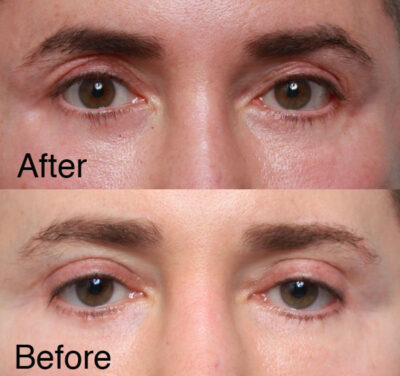
What Causes Lower Eyelid Retraction After Blepharoplasty?
Most cases occur when the original surgery reduces the vertical height of the lower eyelid complex, but this is just what we see. It is the changes in the deep eyelid that actually cause lower eyelid retraction.
This can happen when:
- too much skin is removed
- Motor nerves to the muscular hammock are damaged
- scar contraction develops in the eyelid
- the midface support beneath the eyelid is inadequate due to lack of projection
The lower eyelid does not function independently. It is supported by the cheek and the orbital rim beneath it. When that support is compromised, the eyelid can descend.
Once that occurs, tightening the outer corner of the eyelid does not restore the missing support.
Why Simple Canthoplasty Often Fails
Many surgeons initially attempt to correct eyelid retraction with procedures that tighten the lateral canthus.
These operations include:
- lateral canthopexy
- lateral canthoplasty
- drill-hole canthoplasty
These techniques focus on pulling the eyelid upward by anchoring the outer corner of the eyelid to the orbital rim.
While they can improve horizontal eyelid laxity, they do not replace the lost vertical support beneath the eyelid. In some cases, tighten the outer corner of the eye can actually worsen the position of the lower eyelid by pulling the shortened eyelid under the curvature of the eye surface. This is similar to what happens when one tightens a belt to try to support a pair of pants on a belly.
Patients sometimes undergo multiple procedures of this type without achieving a satisfactory result. In many cases, each prior surgery just uses up the resources that are needed to make a definitive repair.
The Missing Pieces: Restoring Vertical Eyelid Support
When I evaluate patients with post-blepharoplasty eyelid retraction, the problem usually involves four issues:
- The eyelid vertical height has been compromised by prior surgery. That means skin, muscle and fat have been cut out and inevitably form lower eyelid scar tissue. As these tissues heal, the scar contracts causing loss of eyelid height.
- Incisions through the eyelid weaken the muscle hammock that supports the lower eyelid position. Recent studies point to a so-called “preservation” lower blepharoplasty. Don’t believe these anatomic theories. They are inconsistent with what we know about how motor nerves supply the lower eyelid.
- Projection of the bone at the orbital rim helps support the cheek soft tissue. In many cases of post-lower blepharoplasty eyelid retraction, lack of bone strength to support the cheek soft tissue is a significant contributing factor.
- Excessive lower eyelid tightening can actually make lower eyelid retraction worse.
Simply tightening the eyelid margin does not rebuild the underlying support system.
Elevating the Midface With an Orbital Rim Implant and a Hard Palate Graft.
Restoring support for the lower eyelid means putting each element back together to make a comprehensive restoration.
The relative lack of cheek bone support is addressed with a hand–carved ePTFE orbital rim implant. The implant is placed along the orbital rim where it is fixed with titanium microscrews. The cheek soft tissues are vertically lifted and permanently sewn to the edge of the orbital rim implant. This permanently recruits missing skin and soft tissue desperately needed for the repair these eyelids.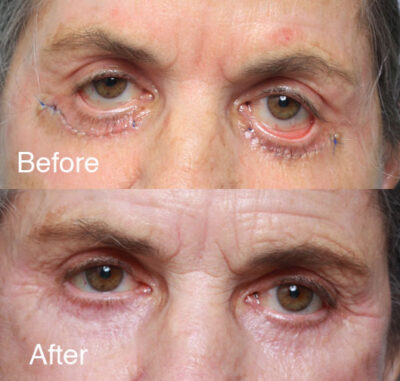
This step is important because the cheek normally provides a supportive platform for the lower eyelid. When the cheek is elevated, that support becomes available again.
Instead of pulling the eyelid upward under tension, the eyelid can rest naturally on the elevated cheek.
Over time, I have found that this structural support dramatically improves the stability of the reconstruction.
Rebuilding the Eyelid With a Hard Palate Graft
Even when midface support is restored, the eyelid itself often requires reconstruction.
For this purpose I commonly use hard palate mucosal grafts. Tissue from the hard palate provides a durable graft that works well in eyelid reconstruction.
The graft acts as a spacer that restores the vertical dimension of the lower eyelid.
Several characteristics make hard palate tissue useful for this purpose:
- structural firmness
- durability over time
- compatibility with eyelid tissues
Once the graft is placed, the eyelid can sit at an appropriate height while maintaining a smooth contour.
Restoring the Lateral Canthal Angle
When the eyelid and midface support are reconstructed, the outer corner of the eyelid can be restored more naturally.
This is an important point. The lateral canthal angle should not be forced upward under excessive tension. When the underlying anatomy is rebuilt correctly, the eyelid assumes a more natural position.
Patients often notice that the eye looks less rounded and more like its original shape.
A Comprehensive Approach to Eyelid Reconstruction
Lower eyelid retraction is a complex problem. Treating it successfully usually requires addressing multiple structural issues at once.
The approach I use focuses on three goals:
- restoring midface support
- rebuilding the vertical height of the eyelid
- restoring the natural shape of the eye
By reconstructing the support system beneath the eyelid, the repair tends to be more stable and more natural in appearance.
Functional Benefits of Reconstruction
Although many patients initially seek treatment for cosmetic reasons, the functional benefits are equally important.
When the eyelid sits too low, the eye becomes exposed. This can lead to chronic irritation, dryness, and discomfort.
Restoring the normal position of the eyelid helps protect the ocular surface and improves comfort.
Patients often report that their eyes feel less dry and irritated once the eyelid position is corrected.
Choosing the Right Surgeon for Revision Eyelid Surgery
Repairing lower eyelid retraction requires experience with oculoplastic reconstruction and revision eyelid surgery.
The anatomy of the eyelid and midface is complex, and treatment planning must be individualized for each patient.
For patients dealing with this complication after blepharoplasty, a comprehensive structural approach often provides the most reliable path to restoring both function and appearance.