
Lower eyelid retraction is one of the most difficult complications of cosmetic lower blepharoplasty. Patients often experience excessive scleral show (the white of the eye beneath the iris), eyelid rounding, dry eyes, tearing, irritation, an unnatural appearance, and, in severe cases, incomplete eyelid closure. Unfortunately, these problems are sometimes compounded when one or more previous repair procedures have failed.
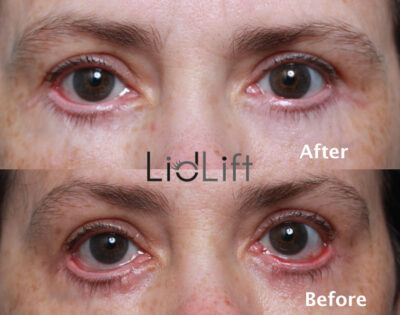
The patient shown here came to Dr. Steinsapir seeking reconstruction of her lower eyelids after developing lower eyelid retraction following a transcutaneous lower blepharoplasty combined with lower eyelid fat grafting. She had already undergone two unsuccessful attempts to correct the problem before seeking consultation.
Why Failed Lower Eyelid Repair Is So Difficult
Patients who have undergone multiple prior surgeries present some of the greatest reconstructive challenges in oculoplastic surgery. Each operation can consume or compromise many of the tissues needed for successful reconstruction. Scarring, loss of tissue elasticity, and disruption of the normal anatomy make each subsequent procedure more difficult and reduce the likelihood of achieving a complete restoration.
For this reason, the goal of revision lower eyelid surgery is not simply to elevate the eyelid. The objective is to restore eyelid support, improve eyelid function, protect the eye, and achieve the most natural appearance possible while avoiding additional aesthetic complications.
It is important for patients to understand that reconstruction is not the same as restoration. Once the normal anatomy has been altered by multiple operations, it is often impossible to recreate the eyelids exactly as they appeared before any surgery. Even so, substantial functional and cosmetic improvement is often achievable with thoughtful reconstructive planning.
Why Simply Tightening the Eyelid Is Usually Not Enough
One of the most common misconceptions is that lower eyelid retraction can be corrected simply by tightening or shortening the eyelid. In reality, these eyelids are frequently deficient in both the horizontal and vertical dimensions. Simply shortening an already compromised eyelid often increases tension without correcting the underlying problem. Successful reconstruction frequently requires replacing missing structural support, recruiting additional healthy tissue, and restoring the normal balance of forces acting on the lower eyelid.
Why Skin Grafting Is Not Always the Best Solution
Skin grafting is sometimes recommended to lengthen the lower eyelid. While skin grafts can effectively add vertical height, they rarely provide an ideal color or texture match with the surrounding eyelid skin. Although a skin graft may improve eyelid position, the aesthetic tradeoff is unacceptable for many patients. Every reconstructive plan must balance functional improvement with the cosmetic appearance of the eyelids.
A Comprehensive Reconstructive Approach
This patient’s reconstruction involved a staged surgical approach that included:
A vertical internal cheek lift to recruit skin and soft tissue into the lower eyelid
Placement of a custom-made ePTFE orbital rim implant to restore structural support
A hard palate graft to replace missing posterior lamellar tissue
The procedures were performed one week apart, with one eyelid repaired first and the other repaired the following week. This staging was necessary because each eyelid needed to remain temporarily sewn closed for approximately one week to optimize graft healing and maximize the likelihood of a successful result.
One-Year Results
She is now one year after completing her reconstruction and has experienced a profound improvement in both lower eyelid position and function.
Although the reconstruction was highly successful, it is important to recognize that reconstruction is not the same as restoration. Her eyelids could not be returned completely to the state they were in before any surgery. Prior unsuccessful procedures often deplete or compromise the very tissues and structural support needed to achieve the most natural reconstruction. Nevertheless, careful surgical planning and the appropriate combination of reconstructive techniques allowed substantial improvement while avoiding additional aesthetic compromise.
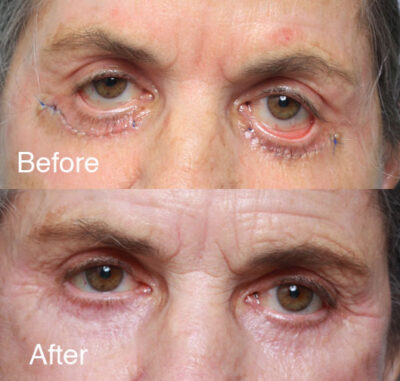
A second patient who presented with severe lower eyelid contraction immediately after her original eyelid surgery. In the after picture, she had both eyelids reconstructed by Dr. Steinsapir using a vertical face lift, custom carved ePTFE implant and hard palate graft. This is a one year result.
Choosing a Surgeon for Revision Lower Blepharoplasty
Revision lower blepharoplasty and lower eyelid reconstruction are among the most technically demanding procedures in cosmetic and reconstructive eyelid surgery. Successful treatment requires a detailed understanding of eyelid anatomy, scar biology, midface support, and the reconstructive options available when previous surgery has altered the normal tissues. This knowledge must be brought together in a result that is both functional and aesthetically appropriate.
A major focus of Dr. Steinsapir’s practice is the reconstruction of complex eyelid deformities following cosmetic blepharoplasty. Over many years, he has developed and refined reconstructive techniques for dealing with the most challenging lower eyelid issues—including the use of vertical internal cheek lifting, custom ePTFE orbital rim implants, and hard palate grafting—to treat patients with some of the most difficult forms of lower eyelid retraction. Patients travel from across the United States and around the world seeking evaluation and treatment for these problems. In many cases, these individuals have been told nothing further can be done for them.
Every case is unique, and the optimal reconstructive plan depends on each patient’s anatomy, prior surgeries, the quality of the remaining healthy tissue, and the functional needs of the eyelids. There is no substitute for an in-depth personal consultation with an experienced oculoplastic surgeon when considering revision eyelid surgery. The first step is to contact us so we can schedule your assessment with Dr. Steinsapir.
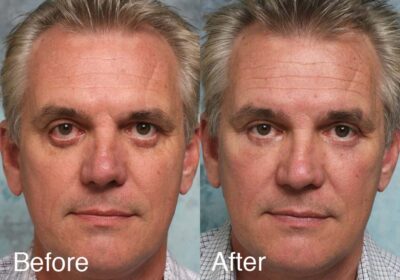
This individual developed post-blepharoplasty lower eyelid retraction after cosmetic eyelid surgery. The after image shows him once Dr. Steinsapir reconstructed his lower eyelids with a vertical face lift, ePTFE rim implant, and hard palate graft.
Frequently Asked Questions About Lower Eyelid Retraction Repair
Will my eyelids get better on their own?
It depends on the cause and severity of the eyelid retraction. Mild postoperative eyelid malposition may improve during the first several months as swelling resolves and the tissues soften. However, significant lower eyelid retraction caused by scarring, loss of structural support, or tissue deficiency is unlikely to correct itself completely. If the lower eyelid remains malpositioned after healing has stabilized, reconstructive surgery may be necessary to restore eyelid function, protect the eye, and improve appearance. An evaluation by an experienced oculoplastic surgeon can help determine whether continued observation or surgical treatment is the most appropriate course.
Can lower eyelid retraction after blepharoplasty be repaired?
Yes. In many patients, lower eyelid retraction can be significantly improved with reconstructive surgery. The treatment plan depends on the severity of the eyelid malposition, the amount of healthy tissue that remains, and whether previous repair attempts have been performed.
Why are failed lower eyelid surgeries more difficult to repair?
Each operation can alter the normal anatomy through scarring, tissue loss, and changes in eyelid support. As a result, revision surgery is often considerably more complex than the original cosmetic procedure and may require advanced reconstructive techniques to restore both function and appearance.
Is simply tightening the lower eyelid enough to correct retraction?
Usually not. Lower eyelid retraction often involves both vertical and horizontal tissue deficiency. Simply tightening or shortening the eyelid may increase tension without addressing the underlying cause. Successful reconstruction frequently requires restoring structural support and recruiting healthy tissue.
Will I need a skin graft?
Not necessarily. While skin grafts can effectively lengthen the lower eyelid, they may not provide an ideal color or texture match. Depending on the individual patient, other reconstructive techniques—such as a vertical internal cheek lift—may reduce or eliminate the need for skin grafting.
Can my eyelids be restored to the way they looked before my original surgery?
One of the most important concepts in revision eyelid surgery is that reconstruction is not the same as restoration. Although substantial improvement in eyelid position, function, and appearance is often achievable, previous surgeries may permanently alter the normal anatomy. Every case is unique, and realistic expectations are an essential part of successful treatment.